Tallahassee, Florida / Since 2021
We don't set 4x4s.
Every privacy fence we build stands on galvanized steel posts. Wood posts move. Steel doesn't. In Tallahassee that difference shows up faster than almost anywhere else in the country.
01 / Climate
The number nobody tells you
You've probably got two or three quotes sitting on the counter. They're within a few hundred dollars of each other, and not one of them tells you what the posts are made of.
Here's why that's the line that matters. The USDA Forest Products Laboratory publishes a decay hazard index for every city in the country. Anything above 65 is considered severe.
On top of that, the building code classifies all of Florida as a “Very Heavy” termite zone. That's the highest of four categories, and there isn't a county in the state that escapes it.
So when we tell you we build differently here, it isn't a sales angle. It's the climate.
02 / Materials
What that actually changes
Galvanized steel posts.
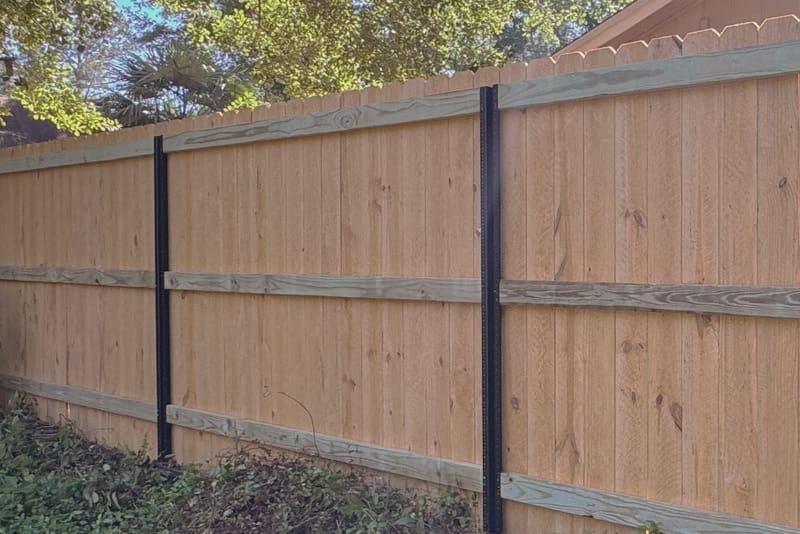
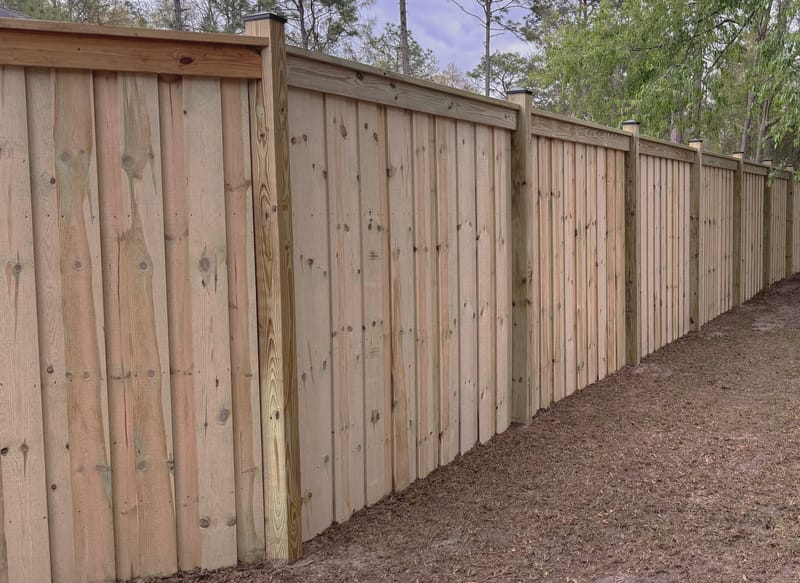
They install behind the pickets, so from either side you still see a wood fence. They don't rot, twist, warp or crack, and they carry a limited lifetime warranty from the manufacturer. When the pickets and rails eventually need replacing, you replace pickets and rails. The posts stay.
Welded steel gate frames.
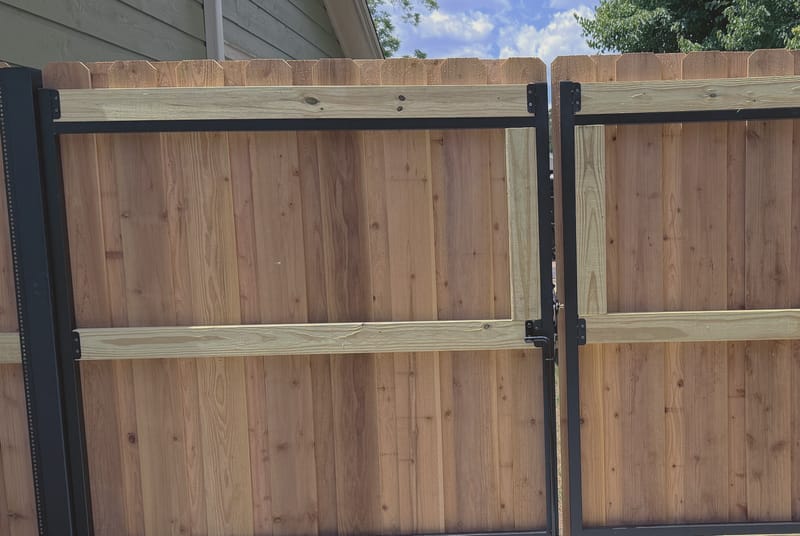
Sixteen gauge, powder coated black. A wood gate frame sags. It's what wood does. A welded steel frame doesn't, so the gate still latches the way it did the day we hung it.
Pre-stained pickets.
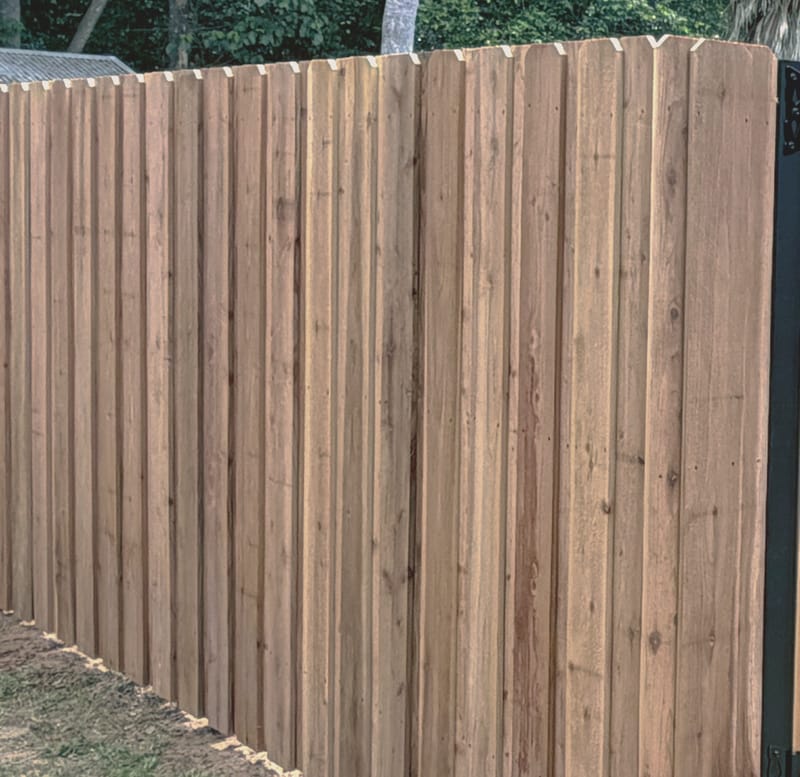
Stained at the factory before assembly, which means every face and every end gets coverage. That matters more than it sounds like it should. Water enters end grain about a hundred times faster than it enters the sides of a board, and end grain is exactly what you can't reach once a fence is built.
03 / Customers
What the last few said
Who actually does the work
He was quick to point out that he would be on site and doing the job himself with his team. I think that is what closed the deal for me. Having the owner of the company doing the work brings the process to a whole new level and you can see it in the craft.
The finished work
The lines are clean, the alignment is precise, and the overall craftsmanship truly stands out. You can tell this fence was constructed to last.
04 / Wind load
The comparison, in numbers
Post spacing is where the difference gets concrete. This is the manufacturer's published data for a six foot solid fence.
| Maximum post spacing, 6 ft solid fence | 70 mph | 90 mph | 100 mph | 110 mph |
|---|---|---|---|---|
| Galvanized steel post | 8.0 ft | 8.0 ft | 8.0 ft | 8.0 ft |
| 4x4 southern yellow pine | 8.0 ft | 6.7 ft | 5.5 ft | 4.5 ft |
At the wind speeds this city actually designs for, a wood post fence needs its posts almost twice as close together to do the same job. Most of them aren't built that way.
05 / Straight answer
About the wood post thing
We should be straight about something, because you'll hear the opposite from people trying to sell you either way.
Pressure treated pine that's properly rated for ground contact is not going to rot out in five years. That's a myth, and the field data doesn't support it.
What actually happens is the post moves. Treated southern yellow pine warps, twists, checks and splits as it dries. Read any treated lumber warranty and you'll find warping, twisting, checking and splitting are specifically excluded from coverage. So the post is still “good” by the warranty's definition while your gate drags on the ground and your fence line has gone wavy.
Steel doesn't move. That's the argument. It isn't more complicated than that.
06 / How we work
How we work
We schedule five days for a three day job. We'd rather have the room and not need it.
Because of that, and because of demand, we're currently booking about five to six weeks out, weather permitting. We know waiting isn't always ideal, but we believe building your fence the right way is worth the wait.
Every quote we send lays out the exact materials, the fastener type, the post spacing, the concrete per post, and photos of the style you're looking at. You'll know what you're buying before you agree to it.
If the lowest bid is what you're after, we're honestly not the right fit, and that's fine. There are people here who'll do it cheaper.
07 / Services
What we build
Wood privacy fences
Board on board, shadowbox, dog ear. Steel posts standard.
View 02Aluminum and ornamental
Including pool code compliant enclosures.
View 03Gates
Welded steel frames, commercial grade hardware.
View 04Farm and ranch fencing
Field fence, no climb, split rail, entry gates.
View08 / Service area
Where we work
Tallahassee and the surrounding area, including Killearn, Buck Lake, Golden Eagle, SouthWood, Bull Run and Ox Bottom. We also work in Wakulla, Gadsden and Jefferson counties.
If you're not sure whether you're inside that, call and ask. It takes a minute to find out.
Ready for a real quote?
Tell us what you're thinking about and we'll come walk the property. No pressure, no same day close, no “this price is only good today.”